

The star has donated the entirety of his £25,000 honor prize money to the MVT, which operates to save the Britain's independent live music spots.
Fender was given the cheque on October 16 as his new release his work was chosen as the best record of the previous year.
Fender has opted to hand the money over to the MVT, in recognition of the essential function small stages fulfilled in his beginning days.
"I personally would not have achieved my current career if it weren't for all the performances I performed around the North East, and beyond, when I was starting out," said Sam Fender. "These venues are iconic, but they are in difficulty."
From early 2023 onward, more than 150 of these spaces have shut down – about 16% of the total UK scene.
In the last year, well-known musicians like Pulp, the group Coldplay, Katy Perry and Ed Sheeran have all supported the Music Venues Trust in its attempts to support the industry, by including a minor surcharge to their ticket prices, which goes to help local stages.
Fender also joined in, generating in excess of £100,000 on his 2024 arena tour to assist numerous small stages across England, Scotland, and Wales.
The donation helped venues that were confronting potential shutdown due to challenges stemming from floods, fires and personal losses, as well as licensing issues, conflicts and sound issues.
Some locations were granted funding support in upgrading amenities and gear that positively impacted performers and audiences.
"The notion that funds from concerts in big venues helps the local stages, where it all starts for musicians like me, is just logical," Fender has stated.
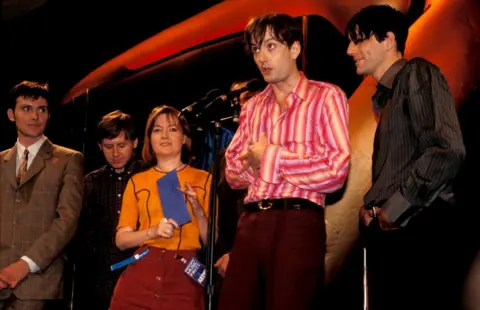
The musician is not the first artist to contribute his Mercury Prize prize money to charitable organizations.
When they earned the trophy in the year 1996 for their album the album, vocalist the singer stated that the band would donate their winnings to the charity War Child.
In 2002, rapper and singer Ms Dynamite divided her prize between a few charities, like the NSPCC and a Sickle Cell organization.
"Additionally, I contributed a grand to the center, to their classes, because I practiced gymnastics when I was younger and they required new equipment," the artist told a publication.
In recent years, they donated their funds to the community center that developed their band, alongside other independent music bodies.
Also 1994 winners they donated their winnings to a charity for MS after a close contact was found to have the condition.
"Receiving the award was quite enough," said singer Heather Small. "The money was the cherry on top but we could do without the bonus, because we had the main prize. So our success impacted the lives of others."
Recently, the Music Venues Trust shared it had rescued two small stages in the South East, by placing them under community ownership.
The Joiners in that area and the other in Bristol were bought under the community ownership program, which is backed by a national body and music fans who acquire "ownership units" in the venues.


